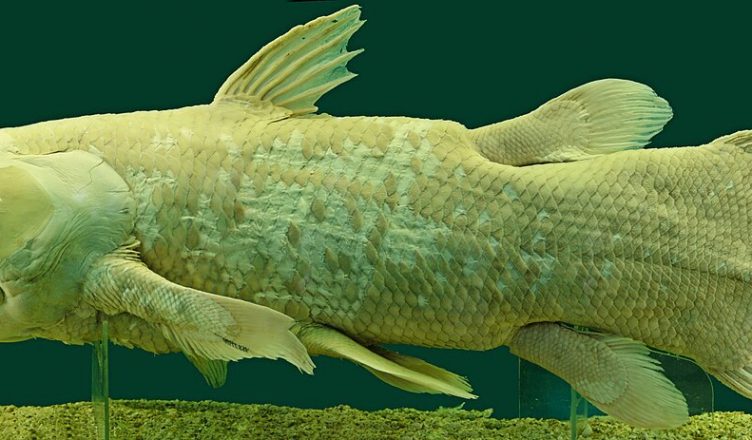
Scientists believed the coelacanth had died out with the dinosaurs, known only from fossils millions of years old. Then, just before Christmas 1938, a living one turned up in a fishing boat’s catch in South Africa. Its discovery was one of the biggest zoological surprises of the 20th century. Here are 20 coelacanth facts that explain what this “living fossil” is and why it matters.
Quick facts
- Living species: West Indian Ocean coelacanth (Latimeria chalumnae) and Indonesian coelacanth (Latimeria menadoensis)
- Rediscovered: 22 December 1938, East London, South Africa
- Size: up to about 2 m and 95 kg
- Habitat: rocky slopes and caves, often 150–700 m deep
- Status: Critically Endangered (L. chalumnae), Vulnerable (L. menadoensis)
1. It was thought to be extinct
Until 1938, coelacanths were known only from fossils. Scientists believed the group had died out at the end of the Cretaceous period, at the same time as the dinosaurs.
2. Its body plan is about 400 million years old
Coelacanths with a body shape similar to today’s species appeared about 400 million years ago.
3. A fishing boat found the first one
On 22 December 1938 the trawler Nerine, captained by Hendrik Goosen, brought a strange blue fish into the port of East London, South Africa. It had been caught between the Chalumna and Ncera rivers.
4. A museum curator spotted it
Marjorie Courtenay-Latimer, curator of the East London Museum, saw the fish among the catch and realised it was something unusual.
5. A professor identified it
Ichthyologist J. L. B. Smith recognised it as a coelacanth and named it Latimeria chalumnae, after Courtenay-Latimer and the Chalumna River.
6. The first specimen was stuffed
Before Smith could see it, the fish had been stuffed to preserve it, so its gills and internal organs were lost. It is still on display at the East London Museum.
7. The second one took 14 years to find
A second coelacanth was not caught until 1952, off the island of Anjouan in the Comoros. It was at first placed in a new genus, Malania, before being recognised as the same species.
8. There is a second living species
In September 1997, Mark Erdmann and Arnaz Mehta spotted a coelacanth at a fish market in Manado, North Sulawesi, Indonesia. A second specimen caught in 1998 led to the description of a new species, Latimeria menadoensis, in 1999.
9. The Indonesian coelacanth is brown
The West Indian Ocean coelacanth is steel blue with white spots, while the Indonesian species is brownish grey.
10. It is a big fish
Female West Indian Ocean coelacanths can reach about 2 metres and males about 1.7 metres. The heaviest known weighed 95 kg.
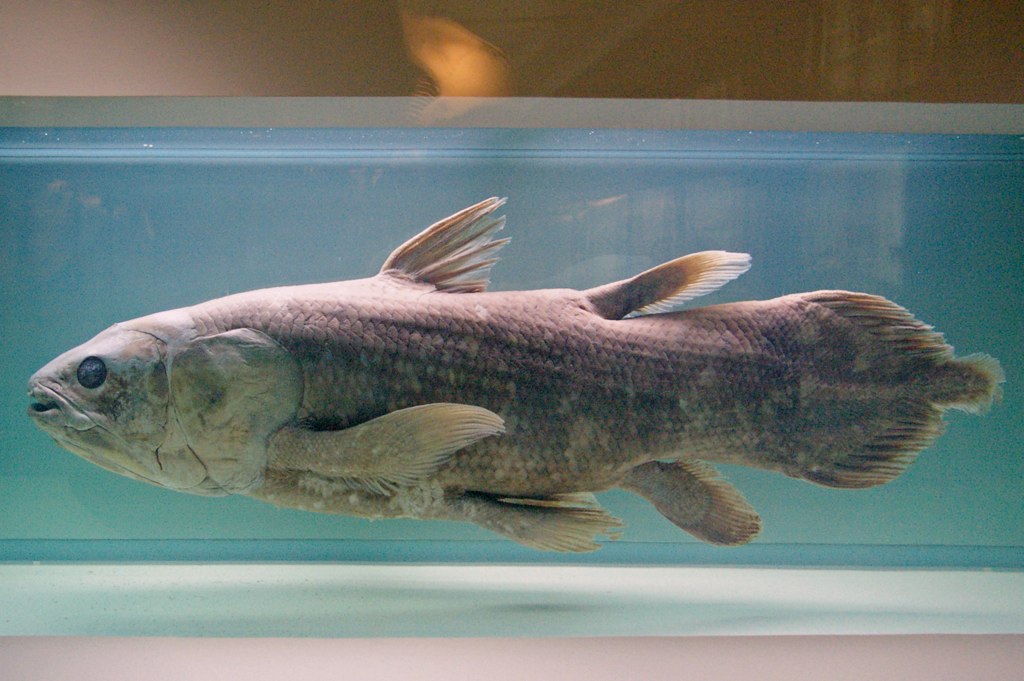
11. It has lobed fins
Coelacanths are lobe-finned fish. Their paired fins grow from fleshy, limb-like lobes, which is why they are closely studied by scientists interested in how fish evolved into land animals.
12. Lungfish are closer to us
A 2013 study of the coelacanth genome showed that lungfish, not coelacanths, are the closest living relatives of four-legged land animals.
13. It has an electric sense
A unique organ in the snout, called the rostral organ, is thought to detect weak electric fields, helping the coelacanth find prey close to its mouth.
14. Its skull has a hinge
Coelacanths have a joint inside the skull that lets both the upper and lower jaws move, possibly giving a stronger bite. This is very unusual among living animals with backbones.
15. It hides in caves by day
Around the Comoros, coelacanths shelter in volcanic caves during the day and come out at night to feed, mostly at depths of about 150 to 700 metres.
16. It does headstands to feed
Coelacanths have been seen doing headstands to suck prey out of cracks in the rocks. They feed on fish and other animals of the deep slopes.
17. It gives birth to live young
Coelacanths are ovoviviparous: the eggs hatch inside the mother, and she gives birth to live pups, usually between 5 and 25 at a time.
18. Pregnancy may last five years
A 2021 study suggested coelacanth pregnancy may last up to five years, among the longest of any animal. Females are thought not to mature until they are about 20 years old.
19. It is Critically Endangered
The West Indian Ocean coelacanth is listed as Critically Endangered by the IUCN. In 1998 the population was estimated at no more than 500 animals. The main threat is accidental capture by deep-sea fishing.
20. “Living fossil” is not quite right
The coelacanth was quickly nicknamed a “living fossil”, but recent studies show that living coelacanths are not simply unchanged copies of their ancient relatives.
How many coelacanths have been caught
Once scientists knew where to look, more coelacanths turned up. Between 1938 and 1975, 84 specimens were caught and recorded, most of them by fishermen around the Comoros.
A dissection that revealed live birth
In 1975 the American Museum of Natural History dissected a female coelacanth and found five embryos inside, confirming that the species gives birth to live young rather than laying eggs in the water.
Eyes built for the dark
Coelacanth eyes contain light-sensitive rod cells and a reflective layer called a tapetum lucidum, like the one that makes a cat’s eyes shine at night. Both help the fish see in the dim water of its deep caves.
A fish full of urea
Unlike most bony fish, the coelacanth keeps a large amount of urea in its blood. This helps it balance salt and water with the sea around it, a trick otherwise used by sharks and rays.
Protecting a rare survivor
The coelacanth has been listed in Appendix I of CITES since 1989, which bans international trade in the species. Surveys in the early 1990s suggested numbers near Grande Comore fell by about 30% between 1991 and 1994, which is why conservationists work with local fishermen to avoid catching them by accident.
Coelacanth FAQ
Why is the coelacanth called a living fossil?
Because it was known only from fossils and thought extinct until a living one was found in 1938.
Where do coelacanths live?
Off eastern and southern Africa, especially around the Comoros, and off Sulawesi in Indonesia.
How many coelacanths are left?
Nobody knows exactly, but the West Indian Ocean species is Critically Endangered, with estimates of a few hundred animals near the Comoros.
Can you eat coelacanth?
It is not a food fish. Its flesh is oily and full of urea, and it is protected because it is so rare.
More remarkable sea creatures: the oarfish, the megamouth shark, the barreleye fish and the megalodon, or explore all our underwater monsters.
Featured image: Alberto Fernandez Fernandez, CC BY-SA 3.0, via Wikimedia Commons.