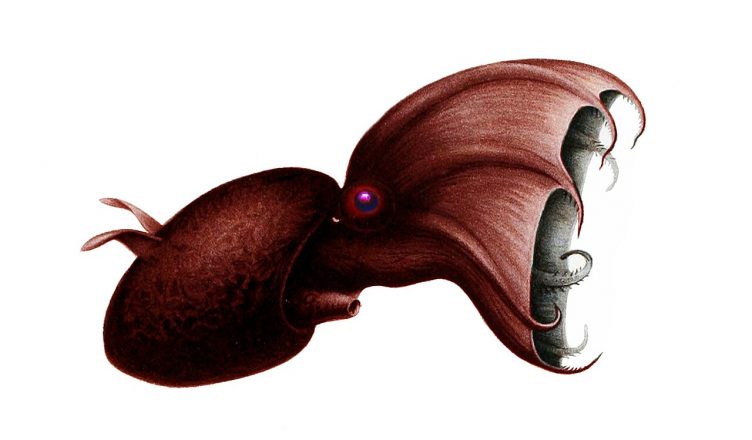
Its scientific name means “vampire squid from hell”, but this small deep-sea animal is neither a vampire nor a true squid. It lives in water with almost no oxygen, eats falling scraps instead of hunting, and when threatened it turns itself inside out and puts on a glowing light show. Here are 20 vampire squid facts that explain what this strange creature really is.
Quick facts
- Scientific name: Vampyroteuthis infernalis
- Order: Vampyromorphida, of which it is the only living member
- Size: up to about 30 cm total length
- Depth: about 600–900 m or deeper, in the oxygen minimum zone
- Diet: marine snow and other drifting scraps
- First described: 1903, by Carl Chun
1. Its name means “vampire squid from hell”
Vampyroteuthis combines the Latin vampyrus, vampire, with the Greek teuthis, squid. Infernalis means “of hell”.
2. It does not drink blood
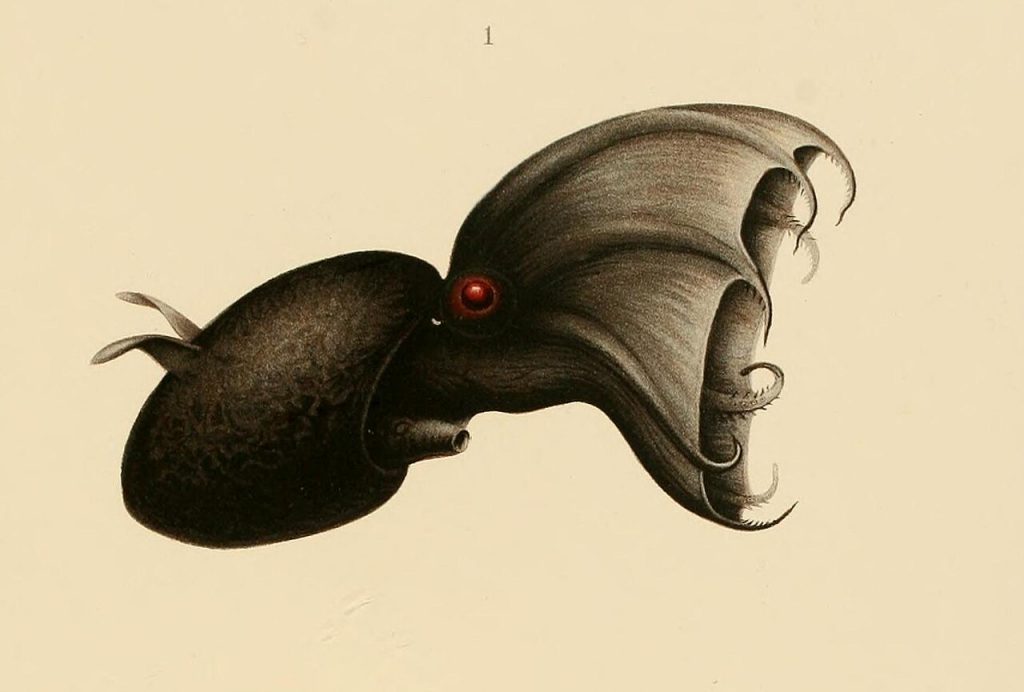
The vampire name comes from its dark colour and the cloak-like webbing between its arms, not from its diet. It is completely harmless.
3. It was discovered on the Valdivia expedition
The species was collected during the German Valdivia expedition of 1898–1899, led by Carl Chun, which set out to prove that life exists deep below the ocean surface.
4. Chun first thought it was an octopus
When Chun described the animal in 1903, he classified it as an octopus. Later scientists realised it was different enough to need its own order.
5. It is neither a squid nor an octopus
The vampire squid is the only surviving member of the order Vampyromorphida. Its closest living relatives are the octopuses.
6. It has two special filaments
Besides eight webbed arms, it has two long, thin filaments that can be pulled into pockets in its body. These set it apart from both squids and octopuses.
7. It is small
A vampire squid grows to about 30 cm in total length, with a body of about 15 cm, roughly the size of a football.
8. It lives where there is almost no oxygen
It lives around 600 to 900 metres down, in the oxygen minimum zone, where oxygen levels can fall as low as 3% saturation.
9. It spends its whole life in that zone
The vampire squid is the only cephalopod known to complete its entire life cycle in the oxygen minimum zone.
10. It has blue blood
Like other cephalopods, it has blue blood based on hemocyanin. Its hemocyanin carries oxygen especially well, and large gills help it make the most of the little oxygen there is.
11. It has a very slow metabolism
Its mass-specific metabolic rate is the lowest measured among deep-sea cephalopods, which lets it survive on very little food and oxygen.
12. It eats marine snow
Instead of hunting, the vampire squid feeds on marine snow, the drift of dead plankton, droppings and other organic scraps falling from above, along with bits of jellies and small crustaceans.
13. It catches food with its filaments
It uses its two sticky filaments to collect falling particles, then wraps the food in mucus to form small balls that it eats.
14. It is covered in lights
Its body is almost covered in photophores, light-producing organs it can switch on and off.
15. It has a “pineapple” defence pose
When disturbed, the vampire squid flips its webbed arms up over its body, showing their spiny-looking undersides. Scientists call this the “pineapple” or “pumpkin” posture.
16. Its arm tips glow as decoys
In the defence posture, the glowing tips of its arms cluster above its head, possibly drawing a predator’s attention away from its body. Lost arm tips can grow back.
17. It can release a cloud of glowing mucus
Instead of ink, a very agitated vampire squid can release a sticky cloud of blue, glowing mucus that can keep shining for almost ten minutes, giving it time to escape.
18. It breeds many times
Unlike most squids and octopuses, which breed once and die, the vampire squid may spawn many times, perhaps more than twenty, during its life.
19. It may brood eggs for a long time
Studies suggest females can carry out long breeding cycles, with brooding lasting up to about 400 days.
20. It may have had a “twin”
In 2024 scientists described a possible second species, but it was later judged to be the same as Vampyroteuthis infernalis, leaving the vampire squid alone in its order.
Proving life in the deep
When Carl Chun led the Valdivia expedition, one of his main goals was to prove that animals live far below 550 metres, at a time when many people believed the deep sea was empty. The vampire squid was one of the creatures that proved him right.
Using light to attract food
The vampire squid does not only use light to defend itself. It has also been observed stirring up tiny glowing organisms in the water around it, which may help attract prey or reveal food nearby.
Arms that grow back
If a predator bites off the glowing tip of one of its arms, the vampire squid can regrow it. Losing an arm tip is a small price for escaping with its life.
A life in slow motion
Everything about the vampire squid is built to save energy: its slow metabolism, its habit of drifting rather than swimming, its diet of falling scraps and its ability to live where oxygen is scarce. Few predators can follow it into the oxygen minimum zone, which gives it a relatively safe home in one of the harshest environments on Earth.
Vampire squid FAQ
Is the vampire squid dangerous?
No. It is small, eats marine snow and lives far below where people swim.
Is the vampire squid a squid?
No. It belongs to its own order, Vampyromorphida, and is more closely related to octopuses.
How deep does the vampire squid live?
Usually around 600 to 900 metres or deeper, in water with very little oxygen.
Why is it called a vampire squid?
Because of its dark colour and the cloak-like webbing between its arms, which reminded scientists of a vampire’s cape.
Meet more deep-sea creatures: the gulper eel, the colossal squid, the barreleye fish and the humpback anglerfish, or explore all our underwater monsters.
Featured image: Carl Chun, Public domain, via Wikimedia Commons.