
The giant oarfish is the longest bony fish in the world, a silver ribbon with a crimson crest that can stretch to around 8 metres. It lives in the deep ocean, is almost never seen alive, and when one washes ashore in Japan, people fear an earthquake is coming. It is probably also the real animal behind centuries of sea serpent stories. Here are 20 oarfish facts that explain what this creature is.
Quick facts
- Scientific name: Regalecus glesne (giant oarfish)
- Family: Regalecidae, with three species in two genera
- Length: commonly about 3 m; record about 7–8 m, possibly up to 11 m
- Weight: up to 272 kg (600 lb)
- Depth: roughly 250 to 1,000 m
- Nickname in Japan: “messenger from the Sea God’s palace”
1. It is the longest bony fish alive
The giant oarfish holds the record as the longest ray-finned, or bony, fish in the world.
2. The record length is about 8 metres
Most oarfish measured are around 3 metres long, but reliable records reach about 7 to 8 metres, and some estimates go as high as 11 metres. Old claims of 17-metre oarfish are almost certainly wrong.
3. It can weigh 272 kilograms
The heaviest recorded giant oarfish weighed about 272 kg, or 600 pounds.
4. There are three kinds of oarfish
The family Regalecidae contains three species: the giant oarfish, Russell’s oarfish (Regalecus russelii) and the streamerfish (Agrostichthys parkeri).
5. It was named in 1772
The Norwegian naturalist Peter Ascanius described the giant oarfish in 1772.
6. It is also called the king of herrings
Other names for the giant oarfish include Pacific oarfish, ribbonfish and king of herrings.
7. It has a bright red crest
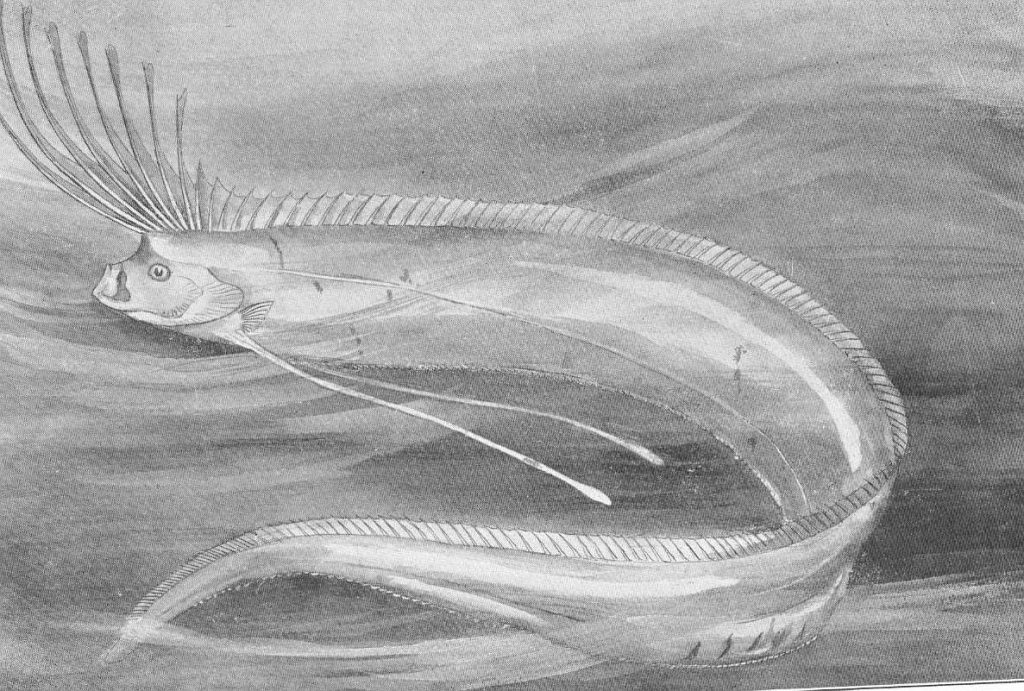
A single dorsal fin runs the entire length of its back. The first 10 to 12 rays are extra long and form a striking red crest on top of the head.
8. Its name comes from oar-shaped fins
The long, thin pelvic fins end in paddle-like tips that look like oars, which gave the fish its name.
9. It has no scales
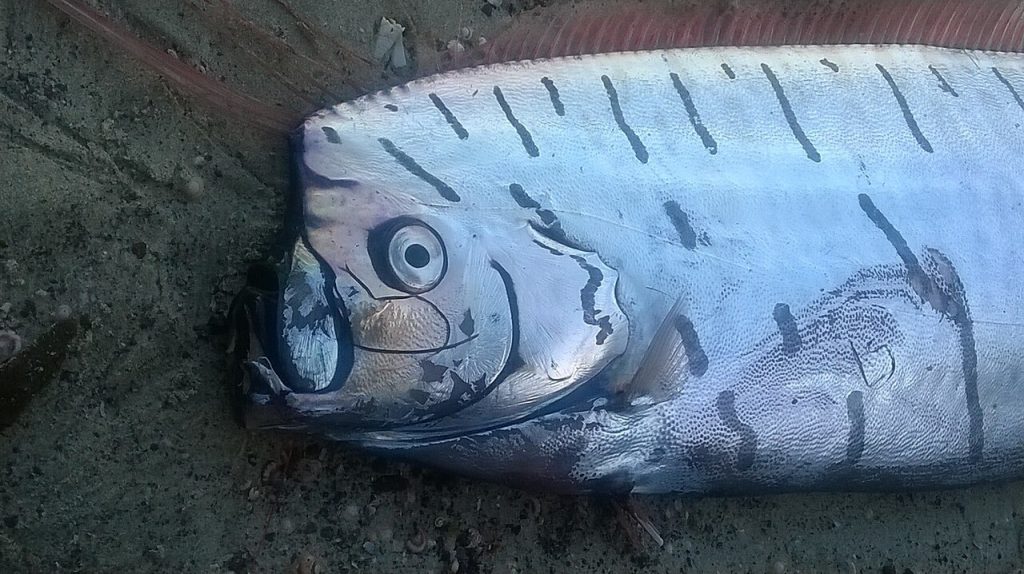
The body is ribbon-like, flattened from side to side and scaleless, silver with dark spots and crimson fins.
10. It has no swim bladder
Oarfish lack a swim bladder. Scientists think they control their depth mainly by rippling their long dorsal fin and moving their tail.
11. It swims standing up
Oarfish often hang vertically in the water, head up and tail down, moving by rippling the dorsal fin while the body stays straight. This position may help them spot prey silhouetted against the faint light above.
12. It lives in the twilight zone
Oarfish live roughly 250 to 1,000 metres down. The deepest verified record of a giant oarfish is about 463 to 492 metres in the Gulf of Mexico.
13. It eats tiny animals
For all its size, the oarfish feeds mainly on zooplankton such as krill and shrimp, along with small fish, jellyfish and squid.
14. It can shed part of its tail
Oarfish can lose the end of the tail, and nearly all specimens longer than 1.5 metres show signs of this.
15. It probably inspired sea serpent legends
Its length, snake-like shape and wavy swimming make the oarfish one of the most likely explanations for sailors’ tales of sea serpents. In 2016 the TV series “River Monsters” reached the same conclusion and filmed two live oarfish in the Mediterranean.
16. In Japan it is the “earthquake fish”
The Japanese name, ryūgū no tsukai, means messenger from the Sea God’s palace. Folklore says oarfish rise to the surface before earthquakes, earning them the nickname “doomsday fish”.
17. The 2011 earthquake revived the fear
About 20 oarfish washed up in Japan in 2009 and 2010, and after the deadly Tōhoku earthquake and tsunami of 2011 many people saw them as a warning.
18. Science found no link to earthquakes
A 2019 study by Japanese researchers compared oarfish sightings with earthquake records and found no real connection, calling the link an illusory correlation.
19. It was first filmed in the wild in the 2000s
US Navy personnel filmed an oarfish near a buoy in the Bahamas in 2001, and the SERPENT research project recorded oarfish with underwater robots in the Gulf of Mexico between 2008 and 2011.
20. Strandings still make headlines
Because they are so rarely seen, oarfish strandings always cause excitement. California, for example, has had only about 20 recorded sightings since 1901, including one washed up on a beach in November 2024.
A fossil from Italy
Oarfish rarely leave fossils. The only known fossil of the giant oarfish is a 35.5 cm section of the rear of the body, found near Macerata in Italy and dated to the late Pliocene, a few million years ago.
How oarfish breed
Little is known about oarfish reproduction, but off Mexico they are thought to spawn between July and December. Their eggs are large for a fish, up to about 6 mm across.
A record catch in England
Oarfish occasionally turn up far from where you might expect. In 2003 an angler at Skinningrove, on the north-east coast of England, caught a 3.3-metre oarfish weighing 63.5 kg on a rod baited with squid.
Live oarfish in Okinawa
Most oarfish are found dead or dying, but in January 2019 fishermen in Okinawa, Japan, found two live oarfish in their nets, adding to the long list of sightings that have fed the earthquake legend.
An ancient Egyptian connection?
Some researchers have even suggested that an ancient Egyptian deity may have been inspired by the giant oarfish, though the idea remains speculative. Either way, the fish has been capturing human imagination for a very long time.
Oarfish FAQ
How long is an oarfish?
Usually about 3 metres, with records of around 7 to 8 metres.
Do oarfish predict earthquakes?
No. A 2019 study found no link between oarfish sightings and earthquakes.
Is the oarfish dangerous?
No. It eats small animals like krill and poses no threat to people.
Is the oarfish the sea serpent?
It is the most likely real animal behind many sea serpent stories, thanks to its great length and snake-like swimming.
More giants of the sea: the megamouth shark, the giant isopod, the colossal squid and the gulper eel, or explore all our underwater monsters.
Featured image: public domain, via Wikimedia Commons.