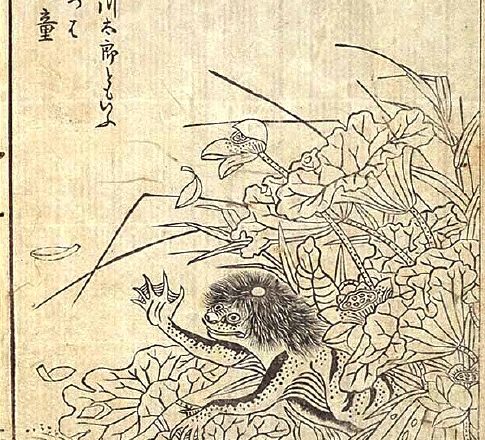
The kappa is a mischievous and sometimes deadly water creature from Japanese folklore. About the size of a child, with a turtle’s shell, a beak and a dish of water on top of its head, it lurks in rivers and ponds, waiting to drag people and horses under. Yet it also loves cucumbers, wrestles for fun and keeps its promises. Here are 20 facts about the kappa, one of the three best-known yokai of Japan.
Quick facts
- Name meaning: “river-child”
- Type: yokai, a supernatural creature of Japanese folklore
- Home: rivers and ponds across Japan
- Look: child-sized, usually green, turtle shell, beak, webbed hands and feet
- Weak spot: the water-filled dish (sara) on its head
- Favourite food: cucumbers
1. Its name means “river-child”
The word kappa is usually explained as a shortened form of kawawappa, combining kawa (river) and a word for child.
2. It has more than 80 local names
Different regions of Japan have their own names for the creature, at least 80 in total, including kawatarō (“river-boy”), kawako, gawappa and garappa.
3. One name means “steed-puller”
In some areas it is called komahiki, which means horse-puller, because of its habit of dragging horses into the water.
4. It is one of the “big three” yokai
The kappa is counted among the three most famous yokai of Japanese folklore, together with the oni and the tengu.
5. It is the size of a child
Kappa are humanoid but small, roughly the size of a young child, which makes them easy to miss in reeds and shallow water.
6. Most kappa are green
Kappa are usually green, but in some places they are said to be yellow-blue, and in Tōno in Iwate Prefecture they are described as red.
7. It looks like a turtle
A kappa has a turtle-like shell on its back, a pointed beak instead of a mouth and slimy or scaly skin.
8. Its hands and feet are webbed
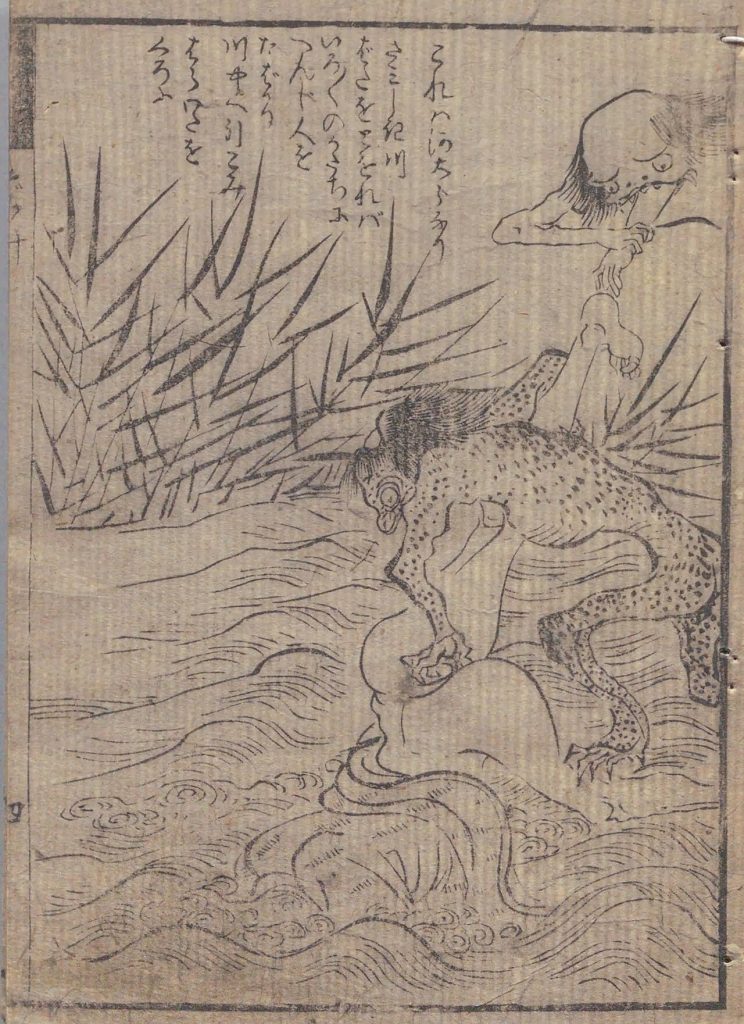
Webbed hands and feet make the kappa a strong swimmer, more than a match for anyone who falls into its river.
9. It carries water on its head
The top of a kappa’s head has a hollow dish, called a sara, surrounded by a fringe of long hair. The dish holds water, which is the source of the creature’s strength.
10. Spilling the water makes it weak
If the water in the dish spills or dries up, the kappa becomes weak and may even die. This is the key to defeating one.
11. You can beat it with a bow
Kappa are said to be extremely polite. If you bow to a kappa, it will bow back, spilling the water from its head and losing its power.
12. It loves sumo wrestling
Kappa love to challenge people to sumo. Tricking a kappa into bowing before the match is the classic way to win.
13. It drowns people and animals
For all its charm, the kappa is dangerous. Stories tell of it pulling swimmers, horses and cattle into rivers and drowning them.
14. It steals a mysterious organ
In folklore the kappa is said to pull out the shirikodama, an imaginary ball believed to sit inside the body. Victims who lose it may die or become dazed and listless.
15. It adores cucumbers
Cucumbers are the kappa’s favourite food. In the Edo period people floated cucumbers down rivers to keep the kappa happy, and the cucumber sushi roll is still called kappamaki today.
16. It once stole squash and eggplant
An encyclopedia from 1712, the Wakan sansai zue, describes the kawatarō stealing squash, eggplant and grain from farmers’ fields.
17. Captured kappa write apology letters
When a kappa is caught, it usually promises to behave and writes a letter of apology. Old families and temples in Japan keep documents said to be these letters.
18. It trades medicine for its arm
A common tale tells of a samurai who cuts off a kappa’s arm. The creature begs for it back and, in return, teaches the samurai a secret recipe for bone-setting medicine.
19. “Kappa hands” are kept as relics
Mummified objects said to be kappa hands are displayed at temples and shrines in many parts of Japan.
20. It may have grown from older water spirits
Scholars link the kappa to several sources, including old Japanese water gods, water serpents called mizuchi, stories of otters, and even Chinese descriptions of gibbons.
Old names in old books
The kappa has been part of Japanese writing for centuries. A dictionary called the Kagakushū, with a preface dated 1444, already uses the word kawarō for a river creature and says an old otter can turn into one. A source from 1754 records another name, kawatora, or “river tiger”.
The red kappa of Tōno
Tōno, a rural area of Iwate Prefecture famous for its folk tales, has its own version of the creature. Here kappa are said to be red rather than green, and the town has long been associated with kappa stories and the ponds and streams where they are said to live.
Kappa in modern art and manga
In the 20th century the kappa became a favourite subject for artists. Ogawa Usen published a book of a hundred kappa pictures, Kappa hyakuzu, in 1938. The cartoonist Kon Shimizu followed with the comic series Kappa kawatarō in the early 1950s and Kappa Tengoku from 1953 to 1958, which turned the kappa from a fearsome river monster into a cute and comic character.
Why the kappa legend lasted
Many folklorists see the kappa as a way of explaining real dangers. Rivers and ponds took the lives of children and animals every year, and a story about a creature that waits beneath the surface was an easy way to keep children away from deep water. The legend’s polite side, with its apology letters and medicine recipes, also gave people a way to imagine making peace with the river.
Kappa FAQ
What is a kappa?
A water-dwelling yokai from Japanese folklore, child-sized with a turtle shell, a beak and a dish of water on its head.
How do you defeat a kappa?
Bow to it. The polite kappa bows back, spilling the water from the dish on its head and losing its strength.
What does a kappa eat?
Its favourite food is cucumbers, which is why cucumber sushi rolls are called kappamaki.
Is the kappa dangerous?
In folklore, yes. It is said to drown people and animals, but it can also be friendly and keeps the promises it makes.
Discover more legends from Asia: the Yeti, the Sigbin of the Philippines, the Mongolian death worm and the stories of Aokigahara forest, or browse all our monster stories.
Featured image: Toriyama Sekien (Japanese, *1712, †1788), Public domain, via Wikimedia Commons.