
Long before anyone spoke of cryptids, Indigenous peoples across North America told of the Thunderbird: a bird so vast that the beating of its wings rolled across the sky as thunder. In the 20th century the legend took on a second life, as farmers, hunters and motorists reported birds far bigger than any known species. Halfway around the world, in the swamps of Zambia, a similar creature called the Kongamato was said to overturn canoes. Are these giant flyers pure myth, mistaken eagles, or something stranger?

[…]
The Thunderbird in Native American Tradition
The Thunderbird appears in the stories of many nations, and each tells it differently. On the Pacific Northwest coast, peoples such as the Kwakwaka’wakw and Nuu-chah-nulth carve it at the top of totem poles and house fronts, wings spread wide. On the Great Plains, the Lakota speak of the Wakinyan, thunder beings who live in the west. Around the Great Lakes, Anishinaabe tradition describes the Animikii, thunder birds locked in an endless struggle with powerful underwater spirits.
Common threads run through these stories. The Thunderbird is enormous and powerful, thunder comes from its wings and lightning flashes from its eyes, and it often battles creatures of the water. In some coastal stories it seizes a whale and carries it off, and the fight between the two shakes the earth. Researchers have pointed out that these accounts may preserve memories of real disasters, such as the great Cascadia earthquake and tsunami of the year 1700.
It is worth stressing that, for these nations, the Thunderbird is a sacred being with deep cultural meaning, not a “monster” waiting to be photographed. The modern cryptid is a different idea that borrowed the name.
Famous Thunderbird Sightings
The Tombstone Legend (1890)
In April 1890 the Tombstone Epitaph in Arizona printed a story about two ranchers who shot a winged monster in the desert, with a smooth body and wings said to stretch more than 50 metres. The tale was almost certainly a tall story of the kind frontier papers loved. Yet it led to one of the strangest puzzles in cryptozoology: many people insist they once saw an old photograph of men posing with a huge dead bird pinned to a barn wall. No such photograph has ever been found, and the “missing Thunderbird photo” is now a classic example of a shared false memory.
The Lawndale Incident (1977)
The most famous modern case happened on 25 July 1977 in Lawndale, Illinois. Witnesses said two very large black birds swooped over a backyard, and one grabbed ten-year-old Marlon Lowe by the shirt and lifted him off the ground for a short distance before dropping him. The boy was unhurt. His mother described birds with a wingspan of around three metres. Wildlife experts suggested turkey vultures, which cannot lift a child, and the family faced years of ridicule. The case still has no satisfying answer.
Alaska’s Giant Bird (2002)
In 2002, residents of villages in southwest Alaska, including a pilot, reported a bird with a wingspan they compared to a small aircraft. Biologists thought the witnesses had probably seen a Steller’s sea eagle, an Asian species with a wingspan of up to about 2.5 metres that rarely wanders into Alaska.
Kongamato: Africa’s “Breaker of Boats”
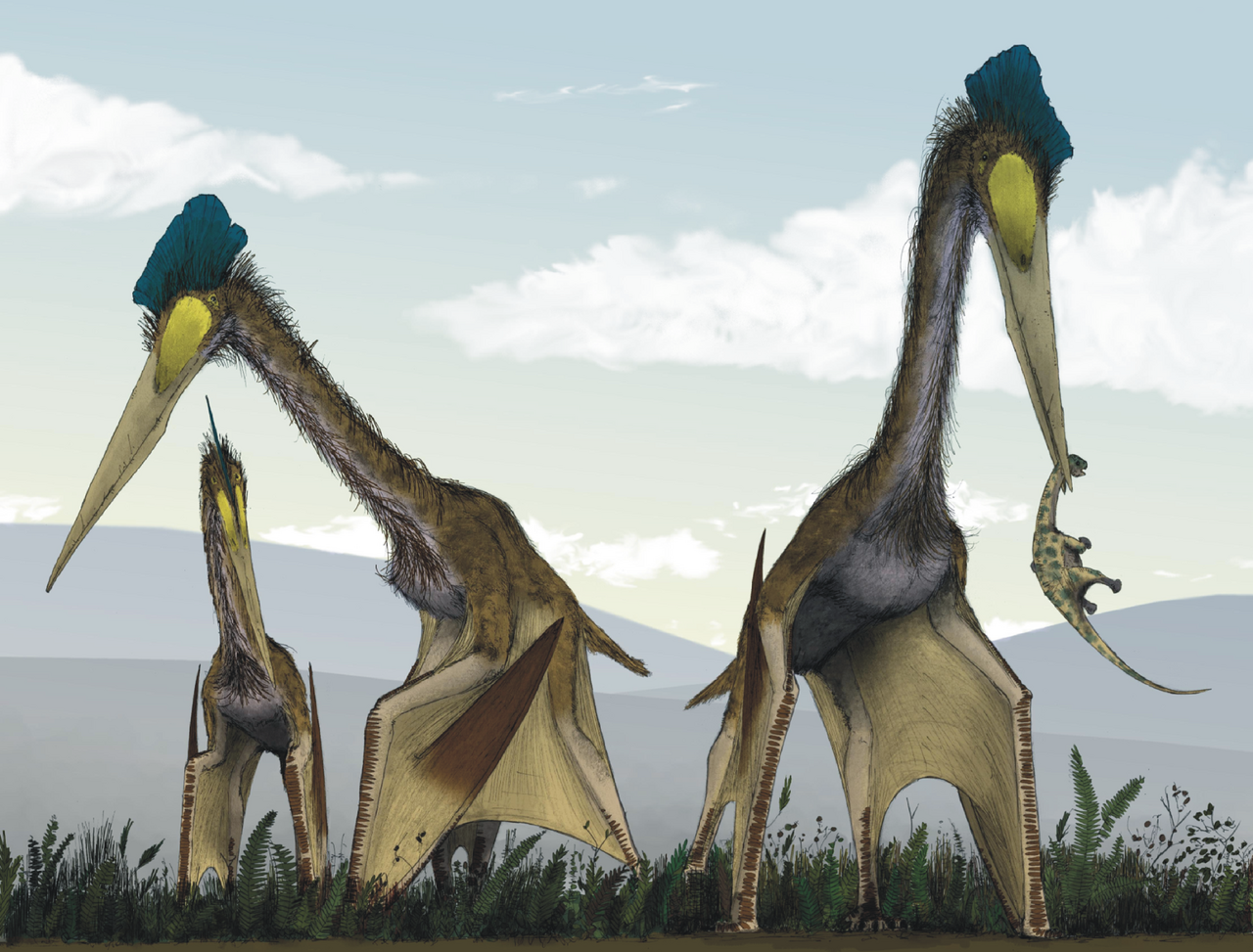
The Kongamato comes from the Jiundu swamp region of northwestern Zambia, then Northern Rhodesia. Its name in the local Kaonde language is usually translated as “breaker of boats” or “overwhelmer of boats”. It was described as a reddish, leathery-winged creature with a long beak full of teeth and no feathers, dangerous to anyone paddling through its territory.
The story reached the West through Frank Melland, a British colonial officer, who wrote about it in his 1923 book In Witch-Bound Africa. Melland claimed that when he showed local people pictures of pterodactyls, they identified them as the Kongamato. That detail turned the Kongamato into one of the best-known “living pterosaur” legends, alongside the Ropen of Papua New Guinea.
[…]
Could Giant Flying Creatures Really Exist?
The fossil record shows that truly giant flyers did once exist. Quetzalcoatlus northropi, a pterosaur from Late Cretaceous Texas, had a wingspan of roughly 10 to 11 metres, about as wide as a small plane. Much later, around six million years ago, a bird called Argentavis magnificens soared over South America with wings spanning perhaps six to seven metres.
The problem is time. Pterosaurs disappeared with the dinosaurs about 66 million years ago, and the great teratorn birds like Argentavis vanished millions of years before humans reached the Americas. A surviving population large enough to breed would need plenty of food, would leave bones and feathers, and would be photographed by today’s countless phone cameras and trail cams.
Likely Explanations
- Large birds of prey and scavengers. California condors have wingspans close to three metres, and bald eagles, golden eagles and vultures look much larger in the air than people expect, especially without anything to compare them against.
- Misjudged size. Estimating the size of a flying object is very hard. A bird seen against an open sky can easily be judged twice its real size.
- African wildlife. For the Kongamato, researchers have suggested the shoebill and saddle-billed stork, both large and strange-looking, and big fruit bats such as the hammer-headed bat, which flies at dusk over rivers.
- Legend and expectation. Once a story of a monster bird spreads, ordinary sightings are more likely to be remembered as something extraordinary.
Thunderbird and Kongamato Quick Facts
(1) The Thunderbird is a sacred figure in the traditions of many Indigenous nations across North America.
(2) In most stories, its wings create thunder and its eyes create lightning.
(3) The 1890 Tombstone Epitaph story is the origin of the famous “lost photo” that nobody can find.
(4) The 1977 Lawndale case is the best-known claim of a giant bird lifting a child.
(5) The Kongamato is said to live in the Jiundu swamp of Zambia.
(6) Its name is translated as “breaker of boats”.
(7) Quetzalcoatlus proves that flying animals with 10-metre wingspans once existed.
(8) No physical evidence of a living giant flyer has ever been found.
Want more strange things in the sky? Read the top Mothman sightings, the Jersey Devil stories from the New Jersey Pine Barrens and the Cold War tale of the Flatwoods Monster. For another “living dinosaur” legend from Central Africa, see Mokele-Mbembe.
Read also: Top 10 Dumbo Octopus Characteristics that Have Helped It Survive | 20 Facts about Sarcastic Fringehead to know what this Creature is | Top 10 Giant Spider Crab Characteristics that Have Helped It Survive