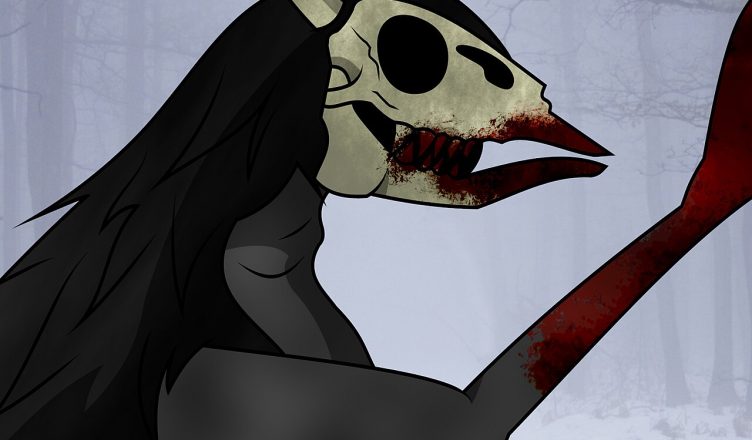
The wendigo is one of the most frightening figures in North American folklore: a gaunt, ever-hungry spirit of winter that preys on people and can turn a human being into a cannibal. Its stories come from Algonquian-speaking peoples of the northern forests, and they are about more than a monster. They are warnings about famine, greed and what happens when a person puts their own hunger above everyone else. Here are 20 facts about the wendigo legend, its origins and the real cases connected to it.
Quick facts
- Origin: Algonquian folklore, including Ojibwe, Saulteaux, Cree, Naskapi and Innu peoples
- Other spellings: windigo, wiindigoo (Ojibwe), wīhtikōw (Cree)
- Associated with: winter, cold, famine, cannibalism and greed
- Typical look: gaunt, ash-grey skin stretched over bones, sunken eyes
- Made famous in English by: Algernon Blackwood’s story “The Wendigo”, 1910
1. It comes from Algonquian folklore
The wendigo belongs to the traditions of Algonquian-speaking peoples, including the Ojibwe, Saulteaux, Cree, Naskapi and Innu, whose lands stretch across the forests of Canada and the northern United States.
2. It can be a spirit or a creature
In some stories the wendigo is a monster that roams the woods. In others it is a malevolent spirit that can possess a person and turn them into a wendigo.
3. The word comes from Cree and Ojibwe
The English word “wendigo” is borrowed from the Cree wīhtikōw and the Ojibwe wiindigoo. A form spelled “Whitego” appears in English writing as early as 1714.
4. Its root may mean “owl”
Linguists have reconstructed a Proto-Algonquian ancestor of the word, *wi·nteko·wa, which may originally have meant “owl”.
5. It is terribly thin
The Ojibwe scholar Basil H. Johnston described the wendigo as gaunt to the point of emaciation, with ash-grey skin pulled tight over its bones and eyes pushed deep into their sockets.
6. It is a giant in many stories
In Ojibwe, Eastern Cree, Naskapi and Innu traditions the wendigo is often a giant, many times taller than a person.
7. It grows with every meal
One of the most chilling parts of the legend is that the wendigo grows bigger each time it eats a person. Because it grows, it is never full, and it stays thin and starving no matter how much it eats.
8. Some stories give it a heart of ice
Some versions say the wendigo has a heart of ice, and that its arrival is announced by a sudden chill in the air.
9. It is a spirit of winter and famine
The wendigo is closely tied to the north, to winter and cold, and to the hunger that came when food ran out in the long northern winters.
10. It stands for greed
Beyond hunger, the wendigo is a symbol of gluttony, greed and excess. The stories warned that selfishness in hard times could destroy a community.

11. The antlers are a modern invention
Many films, games and drawings show the wendigo with a deer skull and antlers. This look comes from modern popular culture rather than the traditional stories.
12. Jesuit missionaries recorded “wendigo” madness in 1661
A passage in the Jesuit Relations from 1661 describes people seized by a frenzy that drove them to kill and eat others, in terms that match later descriptions of wendigo possession.
13. The case of Swift Runner (1878)
Swift Runner, a Plains Cree trapper in what is now Alberta, killed and ate his wife and children during the winter of 1878, near a Hudson’s Bay Company post. He confessed and was executed at Fort Saskatchewan. His case is often linked to the wendigo.
14. The trial of Jack Fiddler (1907)
Jack Fiddler, an Oji-Cree chief and medicine man, was known for protecting his people from wendigos. In 1907 he and his brother Joseph were arrested for killing people believed to be turning into wendigos. Jack took his own life in custody; Joseph was sentenced to life and died in jail three days after being granted a pardon.
15. “Wendigo psychosis” is a disputed diagnosis
Some anthropologists described “wendigo psychosis”, a culture-bound condition in which a person feels an intense craving for human flesh and fears becoming a wendigo. It even appears in the ICD-10 classification of diseases as a culture-specific disorder.
16. Many researchers doubt it was real
In 1982 anthropologist Lou Marano argued that wendigo psychosis was largely a fabrication created by researchers who took stories at face value, and in 2004 James Waldram reached a similar conclusion. Others point to eyewitness accounts, and the debate continues.
17. Algernon Blackwood made it famous in 1910
The British writer Algernon Blackwood published his novella “The Wendigo” in 1910, about hunters in the Canadian wilderness. It brought the name to readers around the world.
18. It inspired other horror writers
August Derleth built on Blackwood’s story with his own wendigo-like being, Ithaqua, in the 1930s and 1940s, and Stephen King’s “Pet Sematary” also draws on the legend.
19. It appears in films, TV and games
The wendigo has appeared in Marvel comics since 1973 and in films and series such as “Ravenous” (1999), “Hannibal” (2013–2015) and “Antlers” (2021), as well as in video games including “Until Dawn” (2015) and “Fallout 76” (2018).
20. Indigenous writers still tell its story
Indigenous authors including Louise Erdrich and Linda Hogan have used the wendigo in their novels, and some critics argue that popular culture too often turns it into a generic monster, losing the moral lessons of the original stories.
The wechuge: a western cousin
The wendigo is not the only being of its kind. Athabaskan peoples of the Pacific Northwest tell of the wechuge, a similar figure linked to cannibal hunger and the cold. Like the wendigo, it shows how northern peoples used stories to talk about the dangers of starvation in winter.
What the wendigo teaches
For the communities that told these stories, the wendigo was never just a monster to scare children. Researchers describe it as a symbol of winter, hunger and selfishness. In a world where a family’s survival depended on sharing food through the hardest months, a person who hoarded or put themselves first was a threat to everyone. The wendigo gave that danger a face.
That is also why the legend is so often connected to greed in modern writing. Indigenous authors and scholars have used the wendigo as a way to talk about overconsumption and the hunger for more that is never satisfied.
How Algernon Blackwood shaped the modern wendigo
Before 1910, the creature was written in English in many different ways, from “Whitego” to “windigo”. Algernon Blackwood’s story fixed the spelling “wendigo” in the minds of readers and set the scene that most later fiction would follow: hunters lost in the vast, silent forests of the Canadian north, and something enormous moving through the trees.
Wendigo FAQ
What is a wendigo?
A malevolent spirit or creature from Algonquian folklore, linked to winter, starvation, cannibalism and greed.
What does a wendigo look like?
Traditional descriptions speak of a gaunt, often giant being with ash-grey skin stretched over its bones and sunken eyes. The antlers seen in modern art are a recent addition.
Is the wendigo the same as a skinwalker?
No. The wendigo comes from Algonquian peoples of the north, while the skin-walker belongs to Navajo tradition in the American Southwest.
Was there a real wendigo case?
Several historical murder cases, such as Swift Runner in 1878 and the Fiddler trial of 1907, were connected to wendigo beliefs, but no wendigo creature has ever been found.
Explore more legends: the Yeti, the Mothman, the Skinwalker Ranch and the Goatman, or browse all our monster stories.
Featured image: DracoLumina17, CC BY-SA 4.0, via Wikimedia Commons.